
September 2, 2026
Teaching Vectors: Starting With the Real World, Not the Formulas
By Sudeep Kumar, Wizen Academy
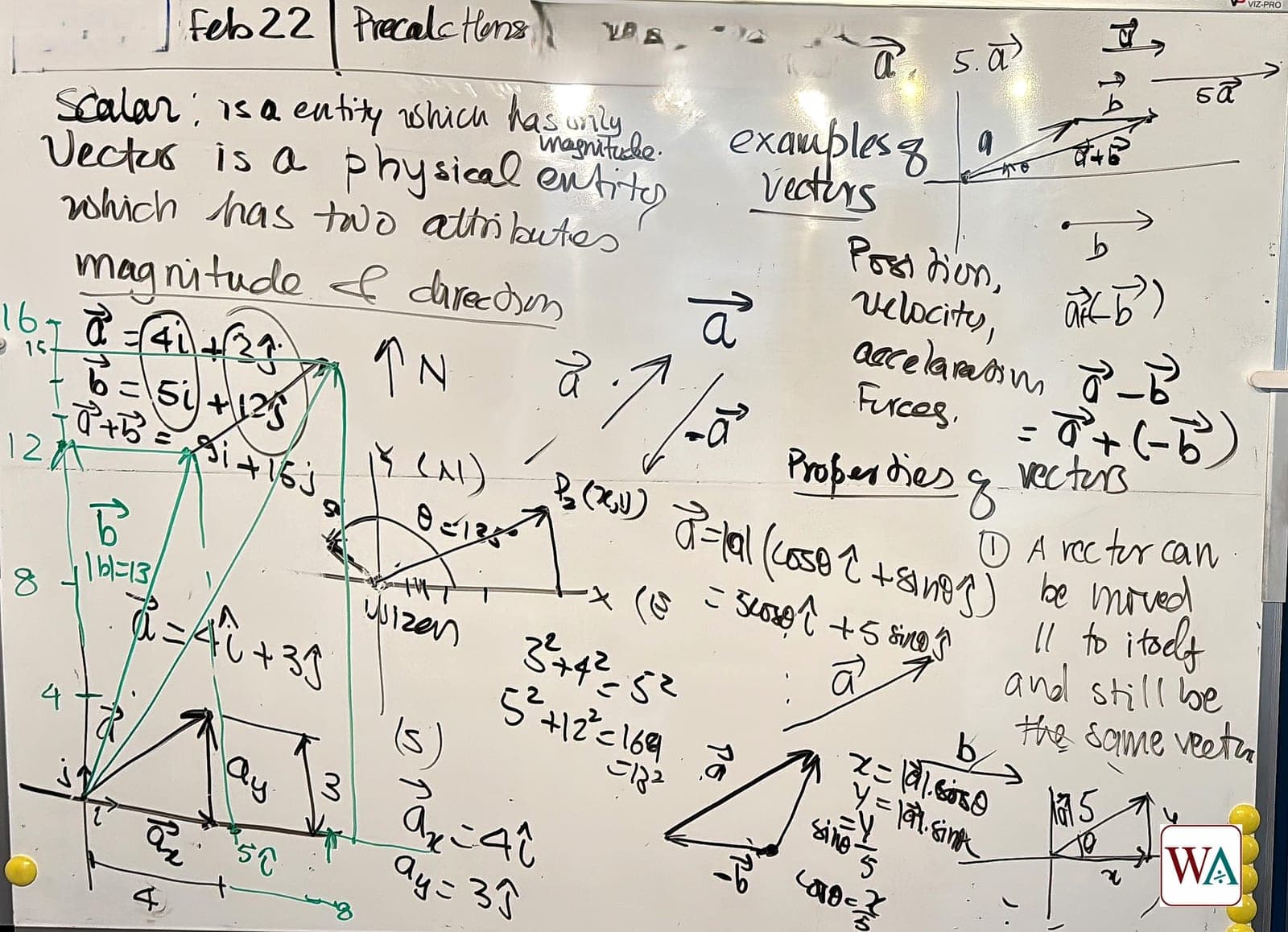
Every new topic in math or physics can feel intimidating the first time it shows up on the board — and vectors are a great example. The moment a student sees an arrow with a magnitude and a direction, formal notation, and Pythagorean-theorem calculations all at once, it's easy to shut down before the idea even has a chance to make sense.
That's why we never start a brand-new topic with the formulas. We start with the world the student already lives in.
In this lesson, before a single equation went on the board, we asked a simple question: what do position, velocity, acceleration, and force all have in common? A student doesn't need to know a shred of vector notation to understand that “how fast, and in which direction” is a completely ordinary way to think about the world — they've been doing it their whole life, riding a bike, throwing a ball, walking to school. Once that clicks, the formal definition — a vector is simply a quantity with both magnitude and direction — stops being new information and starts being a name for something they already understand.
This matters especially here in LWSD, where the district's flexible scheduling means students don't all arrive at a topic with the same background. A student might take Precalculus — where vectors first appear — a full year before ever setting foot in a Physics classroom, so position, velocity, and acceleration haven't been met yet as physical quantities, only as abstract examples on a slide. It happens in the other direction too: a student can start an introductory Physics course before finishing Trigonometry, which turns resolving a force into its horizontal and vertical components — ordinary sine and cosine work — into what feels like a brand-new kind of problem instead of something they already know how to do. Either way, the fix is the same: meet the gap with a real-world, relatable example before the formal math, so the topic never feels stranger than it has to.
Only after that foundation is in place do we bring in the notation: writing a vector as 4i + 3j, finding its magnitude with the Pythagorean theorem, adding vectors tip to tail. By the time the specifics show up, students are organizing an idea they already have, not memorizing one they don't.
This is deliberate, and it's how we approach every new topic, not just vectors: a soft introduction using real-world examples to make the concept relatable, before we delve into specifics — without ever overwhelming a student on day one. Learn more about our teaching philosophy on our About page.
 Scan to register
on your phone